|
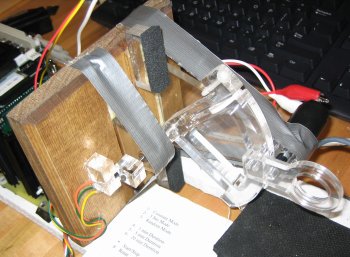
The assembly of the project was quite simple. To enhance the user interface, the paddle was secured to an L-shaped piece of particle board that contained the electronics on one side and the haptic paddle and user controls on the other side. For comfort, we also added a felt pad stuffed with cotton balls. The mechanical portion of the final product was solely the haptic paddle, which was assembled using instructions from a Stanford web page. The paddle turns on the axle, turning the magnet next to the Hall sensor. A kevlar wire is strung across the outer edge of the paddle and wrapped around the shaft of the motor. The assebly for the paddle is outlined below, taken from the Stanford web page.
Haptic Paddle Assembly
- First, make sure that you
have all the parts listed here.
- Second, you will need the
following additional materials to assemble your kit:
- retaining ring tool
- superglue and/or loctite threadlocker
- acrylic cement with
hypo applicator
- Attach
the handle to the sector pulley using acrylic cement. Remember, with
acrylic cement, a little goes a long way! Use the pair of holes and in
each piece for alignment. You can use your shaft (plus another if you have
one) to put in the holes in order to get good alignment. Leave the shafts
in the holes while it dries (about 5 minutes).
- With
acrylic cement, glue the sector pulley and the sector pulley stabilizer
pieces together, using the shaft for alignment. The stabilizer should
be on the same side of the sector pulley as the handle. The holes have a
bit of a taper to them from the lasercam
process, which is why you need the stabilizer. If the holes are too small
to fit the shaft through, use a hand reamer to enlarge the holes. In the
final assembled device, the shaft needs to rotate with the sector pulley,
so try to keep a tight fit.
- Place one bronze bearing in
each acrylic stand. The holes have a slight taper, so place it in the
direction that gives the tightest fit.
- Glue the small and large
acrylic stands to the wood base, using hot glue or epoxy (takes longer to
dry). Again, use your shaft for alignment. Put the large stand in the slot
closest to an edge. The flanges of the bronze
bearings should be facing the outside.
- Now you are ready to assemble
all the pieces on the shaft. The sector pulley goes in between the two
stands. The small triangular piece (stabilizer) on the sector pulley
should face the small acrylic stand.
- Use the retaining ring tool
to place a retaining ring against the flange of each bearing. The sector
pulley and shaft should rotate easily.
- Glue
the motor pulley onto the motor. You can use loctite
or super glue. The pulley should be almost all the way up against the
motor housing. Wait for the glue to dry, then
screw the motor onto the large stand using the metal screws provided.
- Determine where the sector
pulley should be on the shaft. You want there to be lots of overlap
between the pulley and the top surface of the sector pulley, but you don't
want the pulley to bang into the handle. Also, you want most of the extra
shaft length to overhang in front of the small acrylic stand, because the
magnet needs to be mounted there. When you have found
the correct position, glue the sector pulley to shaft with loctite or superglue.
- When
that dries, put on the string. Use the nylon screws and washers to
affix the string at each end of the sector pulley. Wrap the string 3 to 4
times around the motor pulley. The cantilevered part on the sector pulley
is there to help you keep the string in tension. If
you hold it closed when tightening the nylon screws, it will tension the
string when released. Move the handle back and forth to make sure the
string travels properly.
- The next several steps are
for attaching the magnet and sensor. Glue
the magnet to the magnet mount (the small acrylic block with the hole) on
the side opposite of the hole. The magnet should be centered. A bead
of hot glue works fine.
- Glue
the sensor to the sensor mount. Use the tallest direction for the
height of the sensor (it is not a square cube). Superglue works well for
this.
- Glue
the magnet mount (and thus the magnet) to the shaft. You want the
magnet to be horizontal when the sector pulley handle is pointing straight
up.
- Glue the sensor mount onto
the wood base. You want the sensor to be as close as possible to the
magnet without hitting the magnet or its mount. Hot glue is a good choice
here in case you need to move it.
- You
are now done with the assembly. You will want to calibrate your sensor
to determine the relationship between voltage output and angle of the
sector pulley.
|