|
The goal of this website is to explain the Haptic Feedback Finger Trainer made in ME333 at Northwestern University for use by stroke patients. By developing a training apparatus for stroke patients, it is hoped that they will be able to regain dexterity in their hand that is affected by the stroke. This project was done in collaboration with an IDEA design team at Northwestern. Within this website, you will find more information on the design and reasoning behind the Trainer along with detailed instructions on how it is made and works.
| | 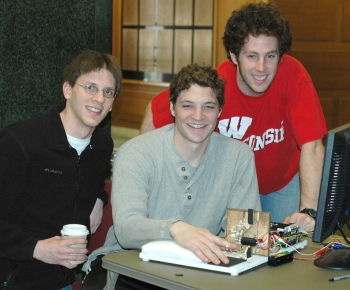 |
| | Jeff Bütz, Mike Duffy, Blake Levine |
Purpose
According to the American Heart Association, about 700,000 strokes occur in America each year. When a stroke occurs, it can leave a person debilitated on half of his/her body. Many times stroke patients have difficult extending and retracting their fingers on one hand. By stimulating the fingers through training them with low resistance for longer durations of time (20 minutes), it is hoped that the patient will be able to recover movement of his/her fingers.
This project was primarily intended for use at a clinic with a physical therapist with the possibility of later creating a less expensive version for use at the home. After meeting with Dr. Campbell from the Rehabilitation Institute of Chicago, many of the parameters for the final project were outlined and are as follows:
- Trainings sessions of 20 minutes daily
- Finger Movement
- Inflection: 20-25 Newtons
- Deflection: 15 Newtons
- 1 inch range from base knuckle (by hand)
- Varying Resistance between training sessions
- Feedback for user and physical therapist
- Trails attempted and succeeded
- Resistance used
- Summary Data
- Average speed
- Max/min speed
- Train weaker fingers more
During this iteration of the design, the goal was to create a proof-of-concept that could be tested on a limited scale in preparing for an alpha prototype.
Project Description
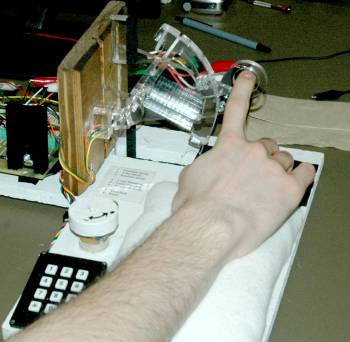
The final Finger Trainer is pictured to the left. A haptic paddle is used for the user interface and is controlled by a motor connected to the paddle with a thin stringed pulley. A PC/104 computer board running the xPC operating system receives a signal of the paddle position measured by a hall sensor and is able to control the resistance of the paddle and implement a training program. The signal from the PC/104 passes through a current amp before going to the motor.
To use the system, the user inserts a finger for training into the paddle. The level of resistance can be dialed in on the control knob to the left of the arm rest, and the training program and duration can be selected on the key pad. After the parameters for the session are set, the pound button is pressed to begin the session. Sessions are started with the finger in the extended state.
With the finger in the extended position, the system will apply a force in the upward direction signaling the user to begin inflection of the finger. Once the finger is inflected the desired distance, the system reverses the resistance to the downward direction, indicating to the user to extend his/her finger. One cycle includes one full inflection and deflection of the finger. Each successful cycle is counted along with the average velocities in each direction. The minimum, maximum and average velocities are also tracked for the entire session. These values are kept for the user to record for training purposes. All values are zeroed by stopping the program.
The technical aspects of the system can be broken down into three parts, the mechanical design, the electrical design, and the software design.
|