Results Page
Injection Molds
There were 5 successful part sets made.
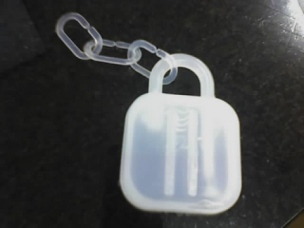
The Completed Part
[Hover your mouse over thumbnail for detail]
Tumbler: As expected, both halves of the tumbler mate successfully. One issue with the tumbler halves was that some of the parts had slight deformation on the flat side. The deformation thankfully does not affect performance of the locking mechanism or the actual mating of the tumbler halves.
On the parts that are deformed, there is shrinkage on the flat side where the male part is. This part uses a lot of material so it most likely took longer to fill and cool, and the edge between the male part and tumbler is highly angled, resulting in high stress and deformation.
The latch and the links came out successfully, although the links are flimsier than we would have liked.
The Locking Mechanism
The locking mechanism works, albeit not quite as effectively as we had aimed for. Some of the discrepancy between the result and our expectation results from the fact that our pin only extends to the parting line (likely due to an NC programming error). The pin and the latch therefore only interact minimally, resulting in a somewhat clumsy mechanism. The latch moves around inside the tumbler more than expected, and it is thus possible to maneuver the latch into place, instead of simply pushing it into place.
Also, the latch stop was included in our design to prevent the latch from being removed from the tumbler. However, we learned from our parts that the stops were too small to be effective.
What We'd Do Differently
Latch: Instead of making both sides of the latch parallel, we would slightly angle the short side out. This would make the locking mechanism a lot stronger, as more force would be required to deform it. We would also increase the latch diameter to at least twice its size (so that it touches the male part of the tumbler), to a) provide more stable movement of the latch and b) to prevent removal of the latch from the tumbler.
Tumbler: We would definitely correct the error in the NC programming that made the tumbler pin half of what we had intended. This would provide more contact surface between the latch and tumbler, and it would make the pin easier to deform.
To address the shrinking problem due to the male part, we would round out the bottom edges of the male part. As of now, the corner on the male part is highly angled, creating a high amount of stress. If we round out the edges, the stresses would be greatly reduced resulting in much less shrinkage.
Links: As mentioned before, the links are quite flimsy due to their small diameter. We designed the link with basically no real knowledge of the material properties of the link, so it was difficult to manufacture links that deformed and yet were sturdy. If we were to do it again, we would increase the diameter of the links.
About Project
The plastic injection mold we chose to create was a lock and chain consisting of three main parts: the tumbler, latch, and links to form the chain. The locking mechanism uses the same principal as those found in common backpack clips
common backpack clips. The latch has flexible ends that deform around the pin on the tumbler and lock into place. The tumbler is composed of two identical square parts that have openings for the latch as well as a mating pin.
Team Info
- Jeff Butz
- Jeff is a senior in the Mechanical Engineering department. He is a member of both tau beta pi and pi tau sigma engineering honor societies and looks forward to working in industry upon graduation in June.
- Ned Cameron
- Ned is a senior in the Mechanical Engineering department. He has concentrated in MEMS, Nanotechnology, and Mechatronics while fulfilling the requirements for his degree. After graduation, he will work as Application Service Engineer for Informance International in Northbrook, IL.
- Sho Fujiwara
- Sho Fujiwara is a junior in Mechanical Engineering. He is concentrating in design, and hopes to either work in finance or engineering.