Lock Design Page
This page is a discussion of the design of the lock and chain and reflects the theoretical dimensions and behaviors of the parts. For our design proposal and early conceptual sketches of the assembly, see the Archive page.
The Lock Assembly
Details of the parts of this assembly are outlined below.

The Lock Assembly ISO

The Lock Assembly
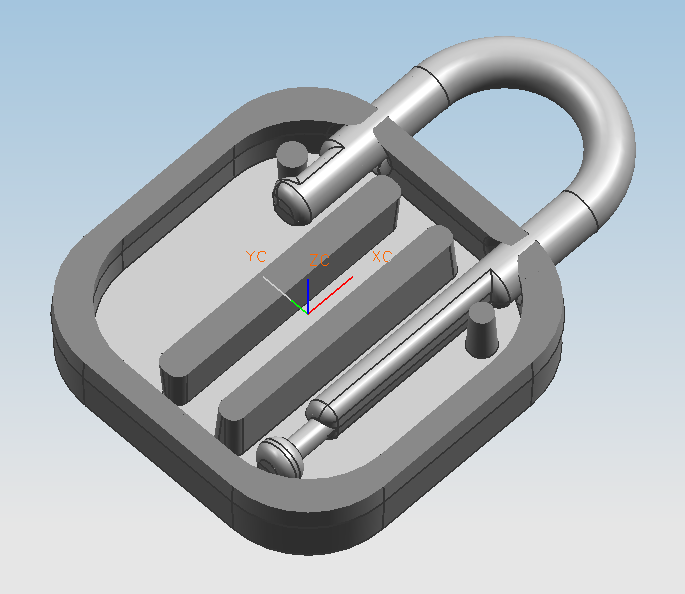
The Lock Assembly Cross-Section
[Hover your mouse over thumbnail for detail]
Latch
The latch is a U-shaped design, and it provides the actual locking mechanism along with the tumbler. One of the ends is long and extends deep into the tumbler, while the other only extends a part of the way. The shorter side has a small indentation on its exterior side, and its location corresponds to the location of the pin on the tumbler.
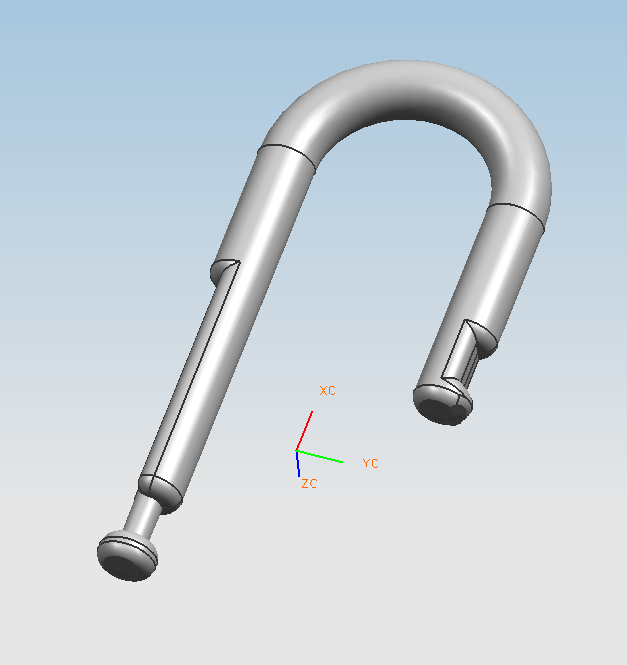
The Latch
[Hover your mouse over thumbnail for detail]
The longer side has a longer indentation on its exterior that runs about halfway down the latch. This design was necessary so that the long end of the latch could move up and down the tumbler without any interference. At the very end of the long side of the latch is a stop that prevents the latch from being fully removed from the tumbler.
- Dimensions
- Long Edge: 2.715 inches
- Short Edge: 1.613 inches
- Width: 0.750 Inches
Tumbler
The tumbler is a clamshell design that uses two identical halves. The tumbler half has two semicircle on one edge that when combined with the other half, create two holes for the latch. Down the middle of each half of the tumbler is a long female part and a corresponding long male part designed so that when the two halves are put together, the two opposing parts mate and provide two stable fits.
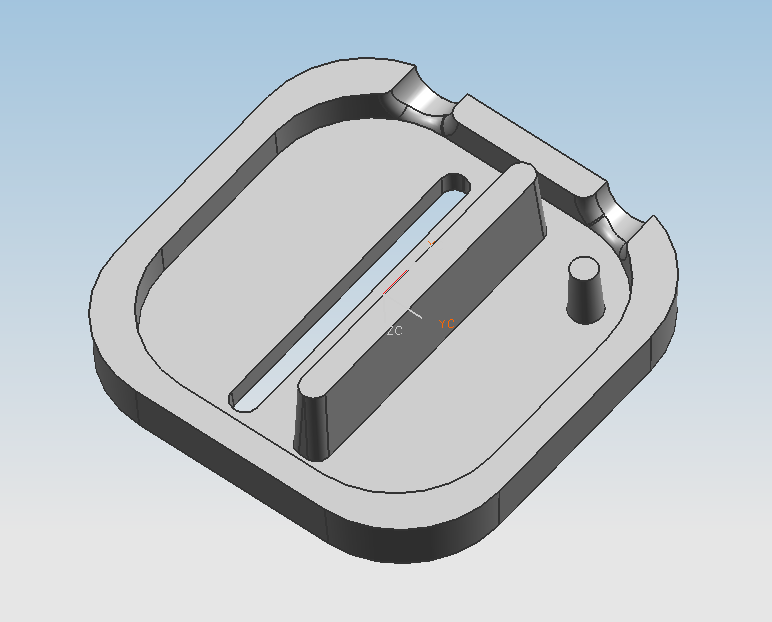
The Tumbler
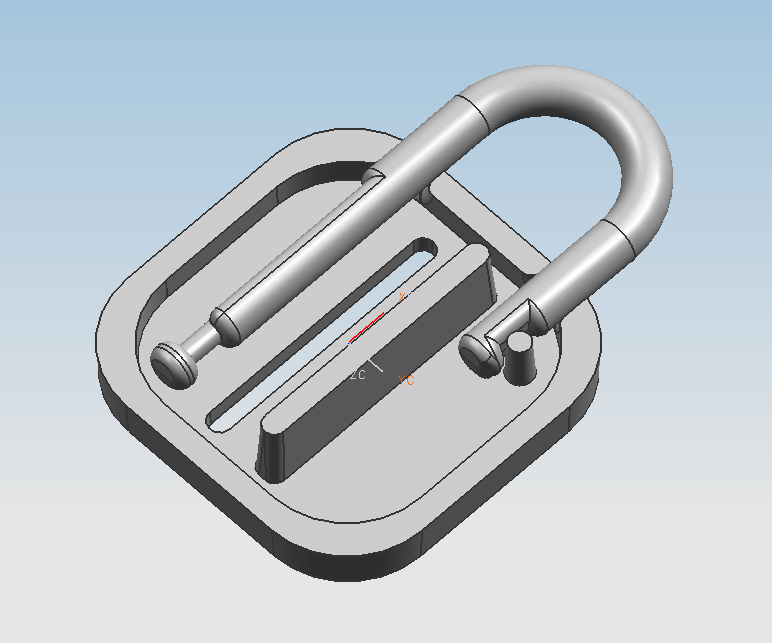
The Tumbler from Top
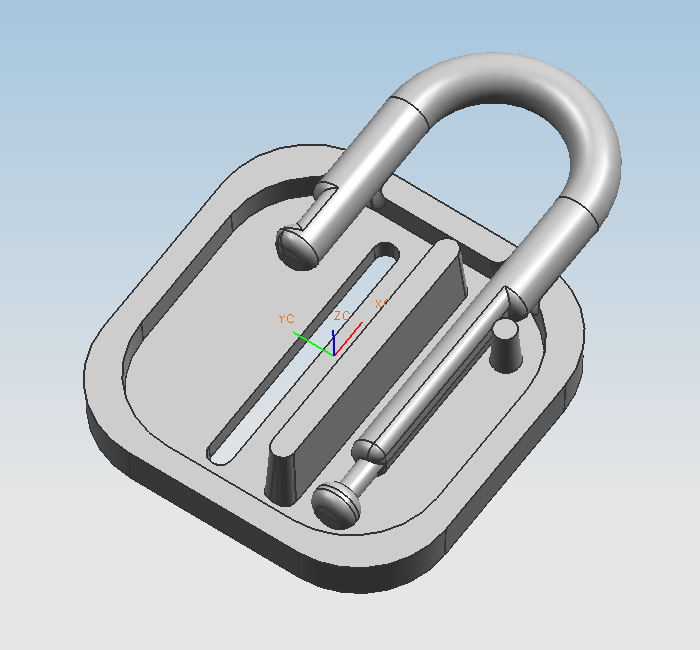
The Tumbler from Bottom
[Hover your mouse over thumbnail for detail]
The way we designed the latch allowed each half of the tumbler to have only one pin. When the tumbler is assembled, there are then two pins on opposites sides of the holes. The functional purpose of the two pins is described in the following "Locking Mechanism section".
- Dimensions
- Width of outer edge: 2.000 inches
- Width of inner edge: 1.750 inches
- Depth: 0.150 inches
Locking Mechanism
The locking mechanism exploits the flexibility of the material. When the latch is inserted all the way into the tumbler, the movement of the shorter end of the latch is blocked by the tumbler pin. The point of contact on the latch is slightly rounded off, and this causes the latch to deform slightly as it is forced in. Further insertion of the latch moves the latch all the way in, and once it straightens, the pin is in the indentation of the latch.
The unlocking mechanism works in the same way. As force is exerted outwardly on the latch, the latch movement is blocked by the tumbler pin. The point of contact on the latch is rounded off on this side as well, so the latch deforms, allowing the end to be pulled out. This mechanism differs slightly from our initial idea, which was to squeeze the latch in order to deform it. Rounding off the end of the latch allowed us to create a locking mechanism that does not require physical squeezing of the latch. The user must simply push the latch in to deform it.
Figures 1 and 2 show the position of the latch on the respective sides of the tumbler when it is in the locked position.
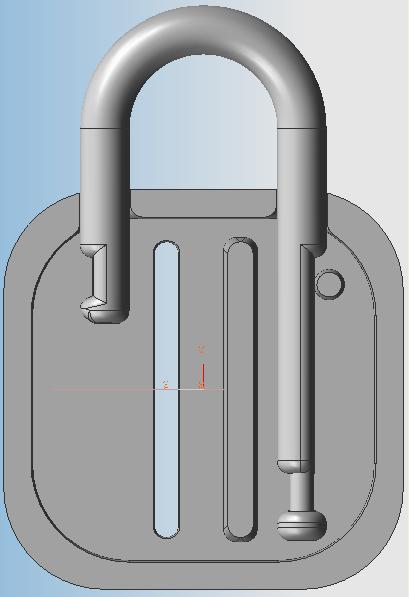
Figure 1
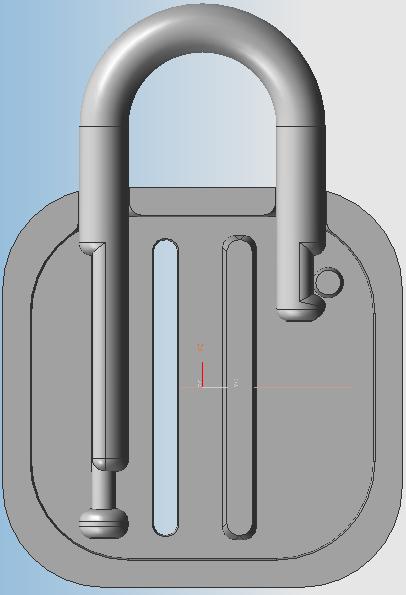
Figure 2

Figure 3
[Hover your mouse over thumbnails for details.]
Figure 3 shows the position of the latch when it is in the unlocked position. As can be seen by the figure, the stop on the end of the latch along with the pin prevents the latch from being fully removed from the tumbler. Thus, the pin serves three main purposes: to aid in the actual locking mechanism (Figure 2), to provide a stable guide for the other side of the latch during vertical movement (Figure 1), and to prevent the latch from being fully removed (Figure 3).
Figure 3 also shows the reason for making the end of the long side of the latch cylindrical. This allows the latch to revolve 360° when the latch is in the fully unlocked position.
The Chain
The Chain consists of a repeating link part which are strung together. The link is a thin oval piece with a small slit on one side to allow them to be strung together. We estimate a chain will consist of about ten links.
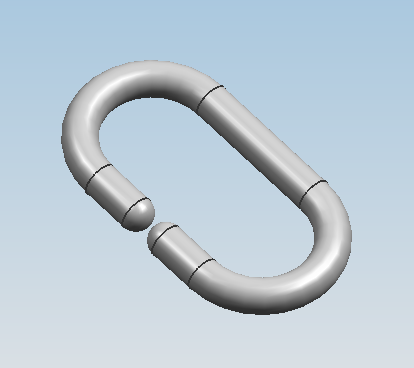
The Link
[Hover your mouse over thumbnails for details.]
About Project
The plastic injection mold we chose to create was a lock and chain consisting of three main parts: the tumbler, latch, and links to form the chain. The locking mechanism uses the same principal as those found in common backpack clips
common backpack clips. The latch has flexible ends that deform around the pin on the tumbler and lock into place. The tumbler is composed of two identical square parts that have openings for the latch as well as a mating pin.
Team Info
- Jeff Butz
- Jeff is a senior in the Mechanical Engineering department. He is a member of both tau beta pi and pi tau sigma engineering honor societies and looks forward to working in industry upon graduation in June.
- Ned Cameron
- Ned is a senior in the Mechanical Engineering department. He has concentrated in MEMS, Nanotechnology, and Mechatronics while fulfilling the requirements for his degree. After graduation, he will work as Application Service Engineer for Informance International in Northbrook, IL.
- Sho Fujiwara
- Sho Fujiwara is a junior in Mechanical Engineering. He is concentrating in design, and hopes to either work in finance or engineering.